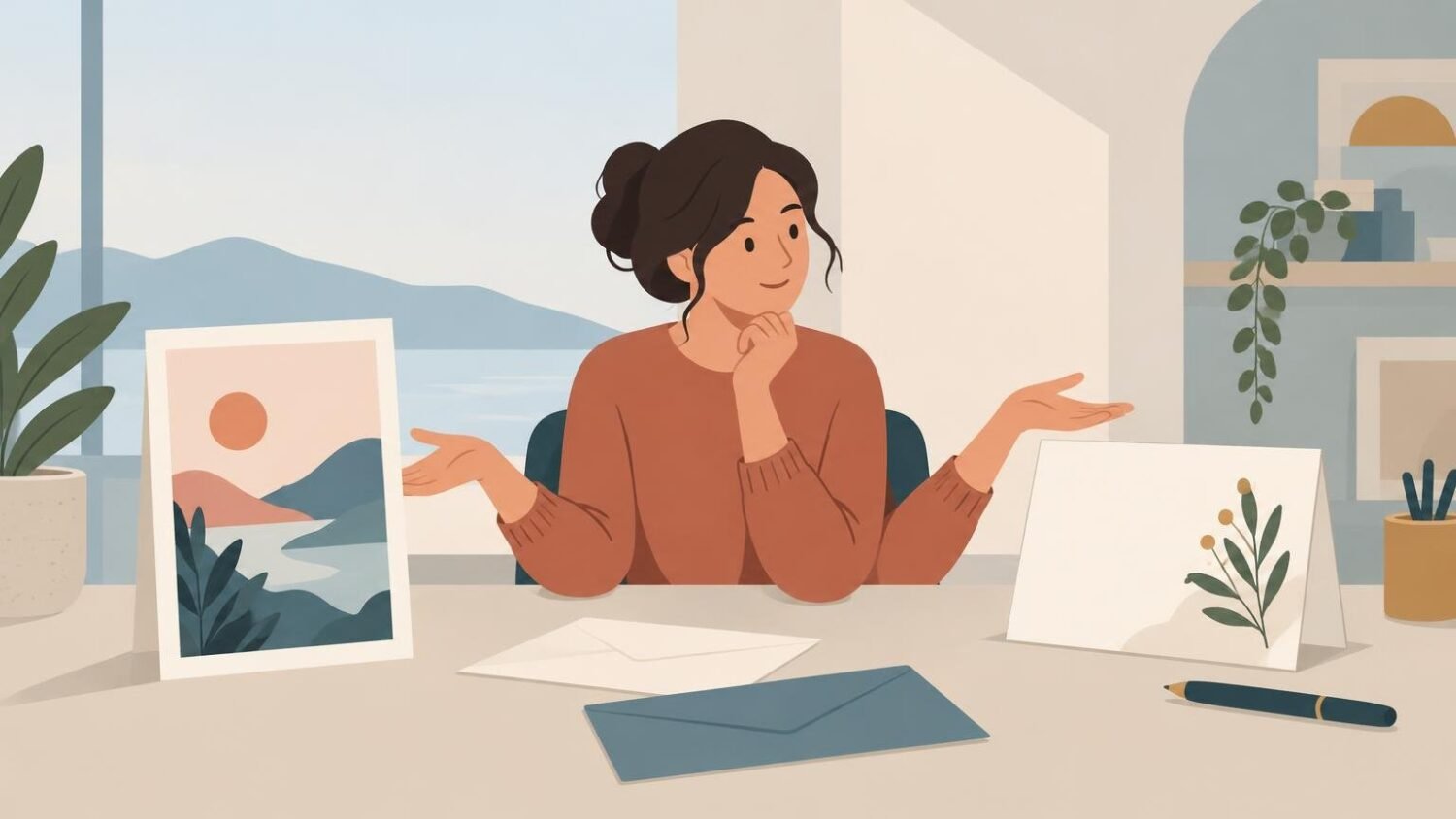
Choose a flat thank-you card when you want a short handwritten message, a prominent photo or a simple design that recipients can see immediately. Choose a folded card when you expect to write more, want the message concealed until the card is opened or prefer a more traditional presentation. Neither format is automatically more personal, more professional or more expensive to mail; the best choice follows from what you need to show and say.
| Decision factor | Flat card | Folded card |
|---|---|---|
| Writing space | Best for a concise note, usually written on the back | More room for a longer message across the interior |
| Photos and artwork | Puts a photo or design front and center | Allows a designed cover plus a separate interior message |
| Presentation | Direct, modern and efficient | Traditional, private and slightly more ceremonial |
| Mailing | Usually paired with an envelope; postcard versions also exist | Normally mailed in an envelope |
| Best fit | Photo thank-yous, short personal notes and repeatable business messages | Wedding gifts, substantial personal notes and formal business correspondence |
Start with how much you expect to write
Writing space is the most useful dividing line. A typical flat card gives you one side for the design and another for the message. Minted, for example, describes a 5.5-by-4.25-inch flat card with a photo or design on the front and a blank back, while its fold-over format has a designed front and a blank interior intended for a longer note.
A flat card works well for three or four handwritten sentences: name the gift or kind gesture, explain why it mattered and close warmly. It starts feeling crowded when the note requires a story, several names or a detailed business follow-up. Tiny handwriting is not an upgrade, even when it technically fits.
A folded card provides more breathing room and lets you keep the exterior visually restrained. It is the safer choice for wedding gifts, sympathy-related kindness, a host who did something exceptional or a client relationship that deserves more than a brisk acknowledgment.
Flat cards give photos more immediate impact
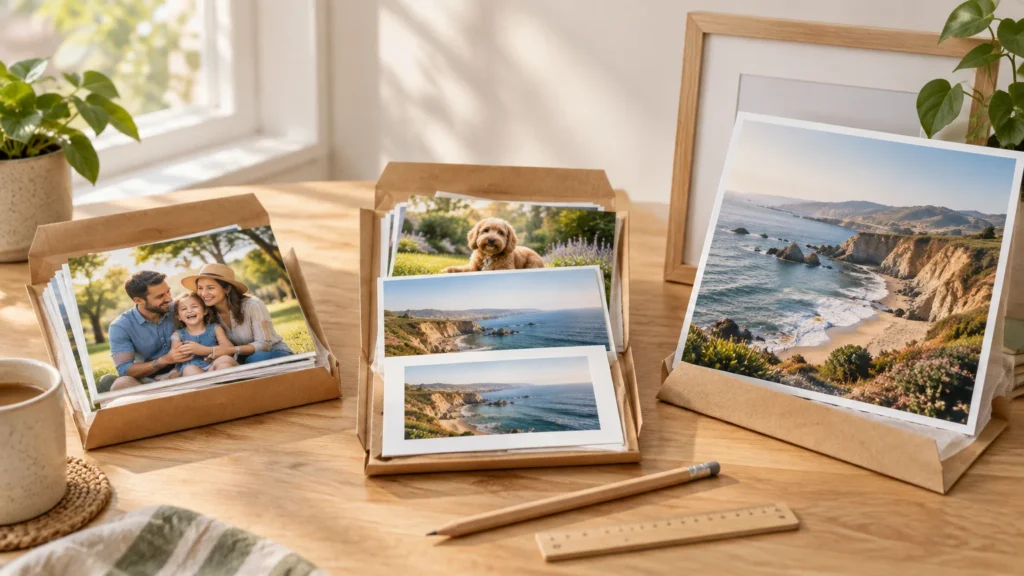
For wedding, graduation and new-baby thank-yous, a flat card can function as both a note and a small photo keepsake. The recipient sees the image as soon as the card comes out of the envelope. Minted and Vistaprint both list flat and folded personalized options, including photo-oriented designs.
Folded cards still accommodate photos, but the cover and message occupy separate moments. That separation can be useful when you want a polished exterior without forcing the handwritten note to compete with an image. It also provides room for a second photo, printed greeting or event details inside, depending on the printer's template.
Formality comes from the whole card, not just the fold
Folded cards often feel more traditional because opening one creates a small sense of ceremony and keeps the message private. Flat cards tend to feel more contemporary and direct. Those are perceptions rather than fixed etiquette rules. Thick paper, restrained typography and a thoughtful handwritten note can make a flat card feel entirely appropriate for a formal occasion.
The Emily Post guidance on business thanks treats handwritten notes as suitable for first meetings and gifts from clients, vendors or associates. It also says a printed note on business stationery can be acceptable when handwriting is impractical. The care taken with the message matters more than whether the paper has a crease.
For a coordinated wedding suite, either format can work alongside invitations and other stationery. Review paper choices before ordering, especially if you want the thank-you cards to match an existing suite; our guide to choosing invitation paper explains the practical differences among smooth, textured and coated stocks. Readers sourcing coordinated cards and invitation stationery can also browse printinvitations.com.
Business and personal uses favor different details
Businesses usually benefit from a format that is easy to personalize repeatedly. A flat card with a logo or branded front leaves the reverse available for a short note. MOO offers reverse-side logo placement and variable artwork across cards in a pack, as well as cards with a coated exterior and an uncoated interior intended to be easier to write on.
A folded business card makes sense for higher-value client gifts, employee milestones or messages requiring several signatures. It also keeps the note out of sight when cards are distributed at an office. For routine order acknowledgments or package inserts, however, a flat card is quicker to handle and gives branding more visible space.
For personal correspondence, choose according to the message. Flat cards suit batches of wedding or graduation thank-yous when each note will be warm but concise. Folded cards help when every recipient needs a more substantial, individual message. Written thanks remain customary for several gift-centered occasions, although both flat and folded designs can fulfill that purpose.
A folded card does not automatically cost more to mail
USPS evaluates the complete enveloped mailpiece rather than charging according to whether the card inside is folded. Size, shape, thickness, rigidity, uniformity and total weight all matter. Current letter-size maximums include 11.5 inches in length, 6.125 inches in height, 0.25 inch in thickness and 3.5 ounces.
That means a conventional rectangular folded card in a suitable envelope does not inherently need more postage than a comparable flat card. Square, rigid, vertical, lumpy or uneven pieces can receive nonmachinable charges or fall into another mail category. Use the USPS First-Class Mail guidance and price calculator with the finished, stuffed envelope before buying postage.
Envelope terms also vary by printer. Minted says envelopes are included and offers recipient addressing; MOO includes white envelopes with its packs; Vistaprint describes envelopes as an option and supplies one per card when selected. Check the final cart rather than assuming every card includes a matching envelope.
Check the printer's production details before ordering
Online services commonly offer flat, folded and postcard-style thank-yous, along with templates, uploaded designs, photos, custom wording, paper choices and envelope services. The labels can hide meaningful workflow differences. Vistaprint says its folded cards arrive flat with a center score for the customer to fold, while MOO advertises multiple paper and finish choices.
The practical decision
Print flat cards if your message is brief, the photo or design should do much of the visual work, or you need an efficient format for many recipients. Print folded cards if you want more writing room, greater message privacy or a traditional opening experience. Then choose paper and finish for the way the card will be used: an uncoated writing area matters more than an impressive sheen that fights every pen in the drawer.
References
- DMM Mailing Standards of the United States Postal Service, Domestic Mail Manual
- First-Class Mail & Postage | USPS
- Wedding Thank You Cards | Personalized Thank You Notes | Minted
- Custom Thank You Cards | VistaPrint
- The Business of Thanks — Emily Post
- Thank You Cards | Custom Business Thank You Cards | MOO (United States)
- Different Ways to Say Thank-You — Emily Post
- Peony Thank You Card set | Paper Source
- Folded Note Cards | Paper Source